
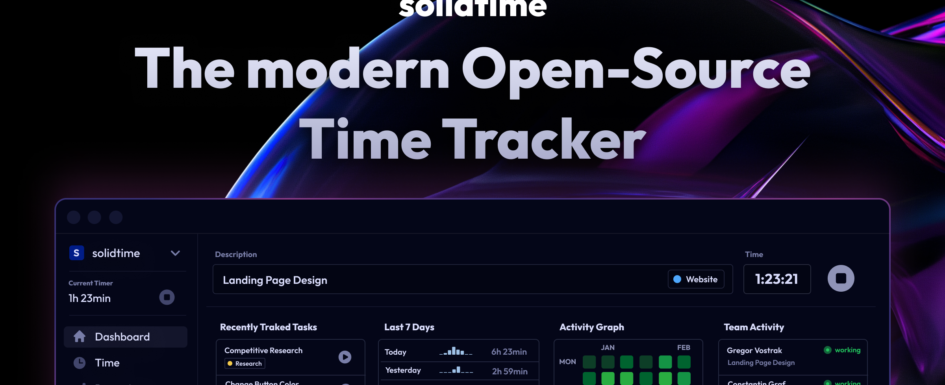
solidtime: Open-Source Time Tracking for Engineers and Engineering Consultants
For consulting engineers, time tracking is more than an administrative task. It underpins invoicing, project control, utilisation and, ultimately, profitability.
The problem is that many time-tracking tools are either bundled into much larger project-management platforms or require you to store business records in another subscription service.
What is solidtime?
solidtime is built around a straightforward hierarchy of organisations, clients, projects, tasks and time entries.
It supports:
- Time tracking
- Clients and projects
- Tasks
- Project members
- Billable rates
- Multiple organisations
- Roles and permissions
- Import from Toggl, Clockify and Timeentry CSV files
That hierarchy is a natural fit for engineering consulting.
A consultant might have one client commissioning a substation upgrade, another requiring an asset-management study, and a third engaging them for a technical investigation. Each engagement becomes a project, with individual engineering activities represented as tasks.
The result is a relatively clean model of where engineering effort is actually being spent.
Why engineers might care
The strongest argument for solidtime is not simply that it tracks hours. Plenty of applications already do that.
Its appeal is the combination of a focused application and an open-source deployment model.
For a small engineering consultancy, time records can become commercially important business information. They reveal which clients consume engineering effort, which projects are profitable and how much non-billable time disappears into administration, business development and internal work.
Being able to manage that information using software you control is therefore valuable.
There is also something appealing about using a dedicated tool for the job. If all you need is reliable project time tracking, adopting a complete ERP or project-management ecosystem can create more administration than it removes.
Where it fits
solidtime looks particularly well suited to:
- Independent engineering consultants
- Small engineering consultancies
- Specialist technical teams
- Engineers working across several clients or projects
- Organisations that prefer self-hosted or open-source infrastructure
It is less compelling if your organisation already has time recording deeply integrated into ERP, payroll, project accounting or enterprise resource-planning workflows.
That distinction is important.
solidtime is not trying to replace an engineering project-control system. Its attraction is that it appears focused on doing one relatively narrow job well: recording who worked on what, for whom, for how long and at what rate.
The engineering consultancy use case
Consider a small electrical engineering consultancy working on:
- a protection coordination study;
- a transformer condition investigation;
- an asset-management strategy; and
- an owner’s engineering assignment.
A useful time-tracking system should make it easy to distinguish not only between those projects, but also between activities within them.
For example:
Client: Mining Company
Project: Substation Upgrade
Task: Protection Study
Engineer: Carlos
Time: 3.5 hours
Status: Billable
That level of structure is enough to support invoicing while also building a much better picture of how engineering effort is distributed across the business.
Over time, those records can become useful management data rather than simply entries on an invoice.
Open source matters
For me, this is one of the more interesting aspects of solidtime.
Time-tracking data is effectively part of a consultancy’s operational history. Years of records can reveal project effort, client relationships, rates and patterns of engineering work.
With an open-source, self-hosted application, you have considerably more control over where that information lives and how the system evolves.
The trade-off is obvious: self-hosting transfers some responsibility back to you.
Someone still needs to deploy, update, back up and secure the application. For a solo engineer who simply wants to start a timer, a hosted SaaS service may be easier.
For a technically capable consultancy already operating its own infrastructure, that trade-off may be entirely reasonable.
What I like
- Focused scope. It solves a clearly defined problem rather than trying to become an entire business-management platform.
- Good consulting model. Clients, projects, tasks, members and billable rates map naturally to professional engineering work.
- Open source. Organisations have the option of running the system themselves.
- Data portability. Import support provides a practical migration path from other time-tracking tools.
- Modern approach. It feels more like a contemporary web application than a traditional enterprise timesheet system.
What to consider
solidtime should not be mistaken for a complete engineering project-management or accounting system.
If you need sophisticated resource planning, earned-value management, payroll, accounting integration or enterprise project controls, you will probably need additional systems around it.
Self-hosting also has a cost, even when the software itself is open source. Infrastructure, backups, upgrades and security all require some attention.
For a small consultancy, the decision ultimately comes down to whether the additional control justifies that operational responsibility.
Verdict
solidtime is a compelling option for engineers who want straightforward project time tracking without committing their operational records to another large SaaS platform.
The client → project → task structure fits consulting engineering particularly well, while billable rates and project membership cover many of the fundamentals needed by a small professional practice.
Its strongest fit is probably the technically capable independent consultant or small engineering consultancy comfortable with self-hosting.
It will not replace project controls, accounting or an ERP system, nor should it. Instead, it occupies a useful middle ground: more structured than a spreadsheet, considerably lighter than an enterprise system, and open enough that you can retain control over your own data.
For engineers who value that combination, solidtime is well worth a look.
https://github.com/solidtime-io/solidtimeView solidtime on GitHub →